A broken garage door spring is one of those problems that feels dramatic the moment it happens. Most homeowners in Los Angeles describe it the same way. A sudden loud bang, almost like a firecracker going off in the garage. Then confusion. The door will not open, or it rises a few inches and gives up. Sometimes it looks normal until you try to lift it and realize it suddenly weighs far more than it should.
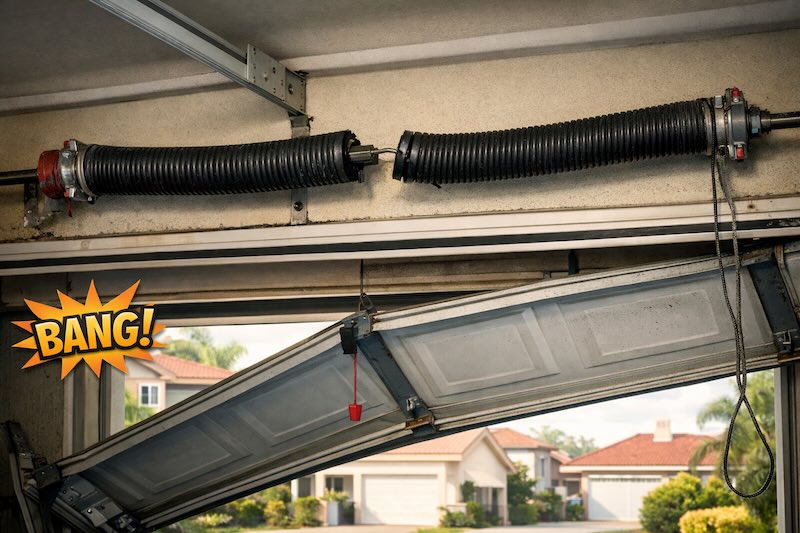
The most common signs are actually pretty consistent. A sharp snapping noise, a visible one to two inch gap in the coiled spring above the door, or a door that feels impossibly heavy when you pull the emergency release. In a healthy system, the springs carry most of the weight. When one fails, that balance disappears instantly. The opener struggles, the door jerks, or it simply refuses to move.
In Los Angeles homes, where garage doors are often used multiple times a day, spring wear shows up faster than people expect. Heat, frequent cycling, and age all play a role. And while the signs are usually obvious, they are not always dramatic. Sometimes the door still opens, just badly. Crooked. Loud. Unsettling.
This guide walks through the real world signs of faulty or broken garage door springs, how to spot them early, and why ignoring them, even for a day or two, often leads to bigger repairs. I think many homeowners wait because the door still kind of works. That is usually the mistake.
What Garage Door Springs Actually Do (And Why Failure Is Sudden)
Garage door springs are not optional components. They are the system. Whether torsion springs mounted above the door or extension springs running along the tracks, their job is to counterbalance the door’s weight. A typical residential garage door in Los Angeles weighs between 130 and 350 pounds. You do not feel that weight because the springs absorb it.
When a spring fails, there is no gradual adjustment period. The tension disappears instantly. That is why the symptoms feel abrupt and sometimes violent.
There are two common spring types you will see in LA homes:
Torsion springs, mounted horizontally above the door opening
Extension springs, usually found along the side tracks on older systems
Both fail differently, but the warning signs overlap more than people expect.
The Most Obvious Signs of a Broken Garage Door Spring
Visible Gap or Break in the Spring
This is often the easiest sign to confirm, if you know where to look. For torsion springs, stand inside the garage with the door closed and look above it. A broken spring almost always shows a clean gap in the coil, usually one to two inches wide. The metal looks stretched, almost wrong.
With extension springs, the break may be less obvious. One side might be hanging lower. Cables can look loose or misaligned.
If you see this gap, the spring is broken. Not worn. Not weak. Broken.
The Loud Bang Sound
Many Los Angeles homeowners report hearing a loud snap that echoes through the garage. Some think something fell. Others assume a car backfired outside. In reality, it is the spring releasing stored tension.
This sound often happens when the door is closed, which confuses people. They try the opener later and discover the problem then.
If you heard a bang and the door will not open afterward, that connection is rarely a coincidence.
The Door Suddenly Feels Extremely Heavy
This is one of the most telling signs, and also one of the most dangerous tests if done incorrectly.
If you pull the red emergency release cord and try to lift the door manually, a properly balanced door should lift smoothly with about 10 to 20 pounds of force. If it feels like lifting a dead weight, the spring has failed.
In some cases, homeowners in Los Angeles manage to lift the door halfway and it drops immediately. That is a failed spring doing nothing to hold the load.
If the door cannot stay open on its own, stop testing. This is how fingers get injured.
Door Only Opens a Few Inches, Then Stops
This symptom shows up constantly with broken torsion springs. The opener starts, strains, and the door rises two to six inches before stopping or reversing.
Sometimes it tries again. Sometimes it just hums.
Garage door openers are not designed to lift full door weight. When a spring breaks, the opener senses resistance and shuts down to protect itself. That protective stop is often the first clue something is seriously wrong.
Continuing to press the opener button does not help. It only risks burning out the motor or bending the rail.
Crooked or Jerky Garage Door Movement
When only one spring fails on a two spring system, the door may still move, but not evenly. One side lifts faster. The other drags. The door looks twisted as it rises.
This uneven movement puts stress on cables, rollers, and tracks. In Los Angeles, where many garage doors are wider double doors, this imbalance becomes especially obvious.
If your door looks crooked while opening or closing, stop using it. That is not a track issue most of the time. It is spring related.
Loose or Dangling Cables Near the Door
Cables rely on spring tension to stay tight. When a spring snaps, cables can slacken, jump off drums, or hang loosely along the track.
Many homeowners notice the cable first and assume it is the main problem. In reality, the cable is reacting to the spring failure.
Trying to reset or pull on a loose cable without fixing the spring is unsafe. The stored energy in the system is unpredictable.
Signs of a Failing, Not Yet Broken Spring
Not all springs fail instantly. Some give warnings, although they are subtle.
Door feels heavier than it used to, but still opens
Opener struggles or sounds strained
Door does not stay halfway open during a balance test
Squeaking or grinding noises near the spring area
In Los Angeles garages, these early signs often get ignored because the door still works. I think that is understandable. Life gets busy. But these are the moments when spring replacement is safer, cheaper, and less disruptive.
Torsion vs Extension Spring Failure Symptoms
| Symptom | Torsion Spring | Extension Spring |
|---|---|---|
| Visible gap | Clear 1–2 inch gap in coil above door | May be stretched or hanging unevenly |
| Loud bang | Very common | Common, sometimes muffled |
| Door opens a few inches | Very common | Less common |
| Door hangs crooked | Common if dual springs | Very common |
| Loose cables | Common | Very common |
Why Broken Springs Are Especially Risky in Los Angeles Homes
Los Angeles garages often serve more than one purpose. Storage, laundry, home gyms, sometimes even living space overflow. A broken spring turns a heavy moving door into a safety hazard in those environments.
Also, many LA homes have older garage door systems paired with newer openers. When springs fail, that mismatch creates more damage faster.
If your door is stuck, slamming shut, or visibly broken, it is best to stop using it and call a professional garage door technician. For homeowners in Los Angeles, working with a local team that understands regional door styles and usage patterns matters.
Learn more about our professional garage door repair services
Spring replacement is not a DIY task. The tension involved is serious, and improper handling leads to injury more often than people realize.
What Actually Causes Garage Door Springs to Fail Over Time
Most homeowners assume garage door springs break because something went wrong suddenly. In reality, the failure usually started years earlier. Springs are rated by cycles. One cycle equals the door opening and closing once. Most standard residential springs are rated for about 10,000 cycles. That sounds like a lot. In Los Angeles homes, it disappears faster than people expect.
Think about daily use. Morning commute. School runs. Grocery trips. Evening outings. Many families use the garage door four to eight times a day without noticing. At six cycles per day, a 10,000 cycle spring lasts under five years. That is assuming perfect conditions, which almost never exist.
Heat and Temperature Fluctuations
Los Angeles does not have harsh winters, but heat plays its own role. Constant warmth causes metal to expand and contract repeatedly. Over time, that weakens the spring steel. Garages without insulation feel this more intensely, especially detached garages or older homes.
Heat alone does not snap a spring, but it accelerates fatigue. Springs become brittle. Micro cracks form. Eventually, one cycle too many finishes the job.
Rust and Moisture Exposure
This one surprises homeowners. Even in dry climates, garage springs rust. Morning condensation, coastal air, and humidity trapped in closed garages all contribute.
Rust increases friction between coils. That friction forces the spring to work harder every time the door moves. I have seen springs that technically should have lasted years longer fail early simply because of surface corrosion.
Routine lubrication helps, but most people forget about springs until something breaks.
Improper Spring Size or Installation
Not all springs are equal. If a spring is undersized for the door weight, it will fail faster. This happens more often than people realize, especially after door replacements or upgrades.
In Los Angeles, modern insulated garage doors are heavier than older single layer doors. If the spring was not upgraded accordingly, the system stays slightly out of balance from day one.
That imbalance stresses the spring on every cycle. Failure becomes inevitable.
How to Tell the Difference Between a Broken Spring and Other Garage Door Problems
Garage door issues often overlap. A door that will not open could be a spring, opener, cable, or sensor issue. But there are clues.
Spring Problem Indicators
Door feels extremely heavy when lifted manually
Loud bang was heard before failure
Visible spring gap or deformation
Door opens a few inches, then stops
Door does not stay halfway open
Not Likely a Spring Issue
Door opens fully but reverses immediately
Remote works intermittently
Door closes but will not open, no resistance
Safety sensors blinking or misaligned
If the door moves smoothly by hand but not with the opener, the issue is usually electrical or opener related. If the door barely moves by hand, the spring is the problem.
For opener related issues, check our garage door opener repair service page.
Why Continuing to Use a Garage Door with a Broken Spring Is Risky
This is where many homeowners push their luck. The door still kind of works. Or they lift it manually once or twice. Or they keep pressing the opener button hoping it will cooperate.
That approach creates secondary damage.
Damage to the Garage Door Opener
Openers are not designed to lift full door weight. When springs fail, the opener absorbs stress it cannot handle. Gears strip. Motors overheat. Rails bend.
A spring replacement might have solved the problem. Now you need both spring and opener repairs.
Bent Tracks and Warped Panels
Crooked lifting causes uneven pressure on tracks and panels. Over time, tracks twist. Rollers pop out. Door panels crack or warp.
In Los Angeles, where replacement door panels can be costly due to size and design, this damage adds up quickly.
Personal Injury Risk
This part is uncomfortable but real. Garage doors weigh hundreds of pounds. Without spring assistance, they fall fast. Fingers, hands, and shoulders are commonly injured when people try to catch or guide a dropping door.
Professional technicians treat broken springs seriously for a reason.
How Long Garage Door Springs Typically Last in Los Angeles
| Usage Level | Estimated Spring Lifespan |
|---|---|
| Light use, 2 to 3 cycles per day | 7 to 10 years |
| Moderate use, 4 to 6 cycles per day | 4 to 6 years |
| Heavy use, 7+ cycles per day | 2 to 4 years |
Can a Garage Door Spring Be Repaired, Or Does It Always Need Replacement?
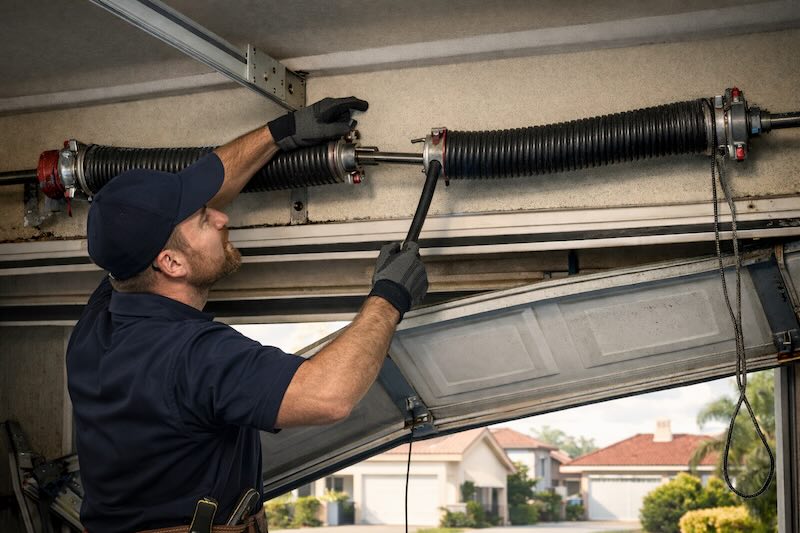
This question comes up constantly. The short answer is no, broken springs cannot be repaired safely. Once a spring snaps, it must be replaced.
Worn springs, however, can sometimes be replaced before failure as preventative maintenance. That is usually the smart move.
In dual spring systems, technicians often recommend replacing both springs even if only one breaks. That advice is not upselling. Springs wear at the same rate. If one failed, the other is usually close behind.
Replacing both restores balance and prevents a second breakdown weeks later.
Why Professional Spring Replacement Matters
Garage door springs store an enormous amount of energy. Improper handling can cause severe injuries. Online videos make replacement look straightforward, but they rarely show what goes wrong.
Professional technicians use calibrated tools, correct spring sizing, and precise tension adjustments. They also inspect cables, drums, bearings, and rollers at the same time.
This full system check often catches secondary issues early.
What to Do Immediately After a Garage Door Spring Breaks
When a garage door spring breaks, most people freeze for a moment. That reaction is actually helpful. The worst thing you can do is rush to force the door open or keep pressing the opener button. The best first step is to stop and assess what you are seeing.
If the door is closed, leave it closed. If it is partially open and unstable, keep clear of the opening and do not try to guide it down by hand. A door without spring support can fall faster than expected, even if it seems to pause briefly.
Safe Steps You Can Take Right Away
There are a few things homeowners in Los Angeles can safely do without tools or risk.
Disconnect the opener using the red emergency release, but only if the door is fully closed
Visually inspect the springs from a distance, do not touch them
Check for a visible gap, dangling cables, or twisted tracks
Make sure no one, including pets, uses the garage door
If your car is trapped inside, that is frustrating. I think this is the moment many people try to muscle the door up. That is where injuries happen. It is safer to call a professional and explain the situation.
Can You Temporarily Use a Garage Door With a Broken Spring?
Technically, sometimes. Practically, it is a bad idea.
In rare cases, a door with one broken spring in a two spring system may still open with assistance from the opener. That does not mean it should. Every cycle risks damaging the opener, cables, tracks, and door panels.
In Los Angeles homes with insulated or custom doors, this damage escalates quickly.
If you absolutely must move the door once, such as to remove a car, it should be done with professional help. Technicians use clamps and controlled lifting techniques to manage the weight safely.
Preventing Garage Door Spring Failure Before It Happens
This is the part most blogs gloss over, but it matters. Springs do not need much attention, but they do need some.
Annual Balance Testing
Once or twice a year, disconnect the opener and manually lift the door halfway. A properly balanced door should stay in place. If it drops or rises, the springs are out of balance.
This test does not fix anything, but it tells you when to act early.
Lubrication and Visual Checks
Light lubrication of springs reduces friction and slows rust formation. It takes five minutes. Most homeowners never do it.
Look for:
Rust spots
Uneven coil spacing
Frayed cables near the drums
If you see these, it is time for service, not later.
High Cycle Springs vs Standard Springs
| Spring Type | Cycle Rating | Best For |
|---|---|---|
| Standard torsion spring | 10,000 cycles | Light to moderate use |
| High cycle torsion spring | 20,000 to 30,000 cycles | Heavy daily use, families |
Common Myths About Garage Door Springs
“The Door Is Old, So This Is Normal”
Age contributes, but usage matters more. A five year old door used eight times daily may have more wear than a fifteen year old door used twice daily.
“If One Spring Breaks, Replace Only That One”
This feels logical. It is also short sighted. Springs installed together wear together. Replacing only one often leads to the second breaking shortly after.
“The Opener Can Handle It”
No opener is designed to replace spring tension. Using it that way causes damage and voids warranties.
When Spring Failure Leads to Full Garage Door Replacement
Sometimes, spring failure exposes deeper problems. Bent panels. Warped tracks. Cracked hinges. In those cases, repair costs approach replacement costs.
Los Angeles homes with older wooden or custom doors see this more often. A professional inspection helps determine whether repairing the system makes sense or whether replacement is more cost effective long term.
FAQs About Broken Garage Door Springs
Is a broken spring an emergency?
Yes, if the door is stuck open, partially open, or unstable. It is a safety risk and should be addressed quickly.
How long does spring replacement take?
Most professional replacements take one to two hours, including balancing and safety checks.
Will my opener be damaged if I stop using the door?
No. Stopping use protects the opener. Continued use causes damage.
Can weather affect spring lifespan?
Yes. Heat, moisture, and coastal air all contribute to faster wear in Los Angeles environments.
Final Thoughts on Spring Failure Signs
Garage door springs fail suddenly, but the warning signs usually show up earlier. Heavy doors, uneven movement, strange noises, and visible wear are all signals asking for attention.
Ignoring them often turns a simple spring replacement into a larger repair. Addressing them early keeps costs predictable and prevents safety risks.
If your garage door shows any of these symptoms, scheduling an inspection sooner rather than later is the smart move.