A garage door opening on its own is usually traced back to a few common issues, a stuck remote button, signal interference from a neighbor’s opener, or faulty wiring in the wall button or safety sensors. Sometimes it feels almost strange, like the door has a mind of its own. But in reality, there is always a cause, even if it takes a bit of patient checking to uncover it.
In most cases, the fix is simpler than people expect. Changing remote batteries, resetting the opener’s memory, cleaning and aligning sensors, or repairing a shorted wire often solves the issue completely. Still, when it happens at night or while you are not home, it naturally raises concerns about security and safety. I think that’s what bothers most homeowners first, not the inconvenience, but the uncertainty.
In Los Angeles and nearby areas, this problem shows up more often than people realize. Dense neighborhoods, multiple wireless devices, older homes with aging wiring, and environmental dust all play a role. One opener reacts to another. One wire rubs just enough to create a short. One sensor collects just enough grime to misread the situation. Small things stack up.
Before diving into the deeper causes, it helps to start with a few quick checks. These alone solve a surprising number of cases.
Key Troubleshooting Steps (Start Here First)
Sometimes you do not need a technician at all. Just a little systematic testing.
1. Check All Remotes
Take the batteries out of every remote in your house. All of them.
If the door stops opening randomly, then you already found your answer. One of the remotes has a stuck or shorted button.
This is more common than people expect. Remotes fall. They get stepped on. They get wedged between car seats. The rubber button membrane weakens over time.
2. Reset the Opener Memory
Hold the “Learn” button on the motor unit for about 6 to 10 seconds.
This erases all programmed remotes. Then reprogram each one carefully.
This clears out any unknown signals that may have been stored accidentally. It also helps eliminate interference issues from nearby garages.
3. Inspect Wiring
Look at:
Wall button wires
Safety sensor wires
Any exposed wire along the track
Check for staples that pierced the insulation or spots where the wire rubs against metal. A tiny short can behave like a constant “open” signal.
4. Clean and Align Sensors
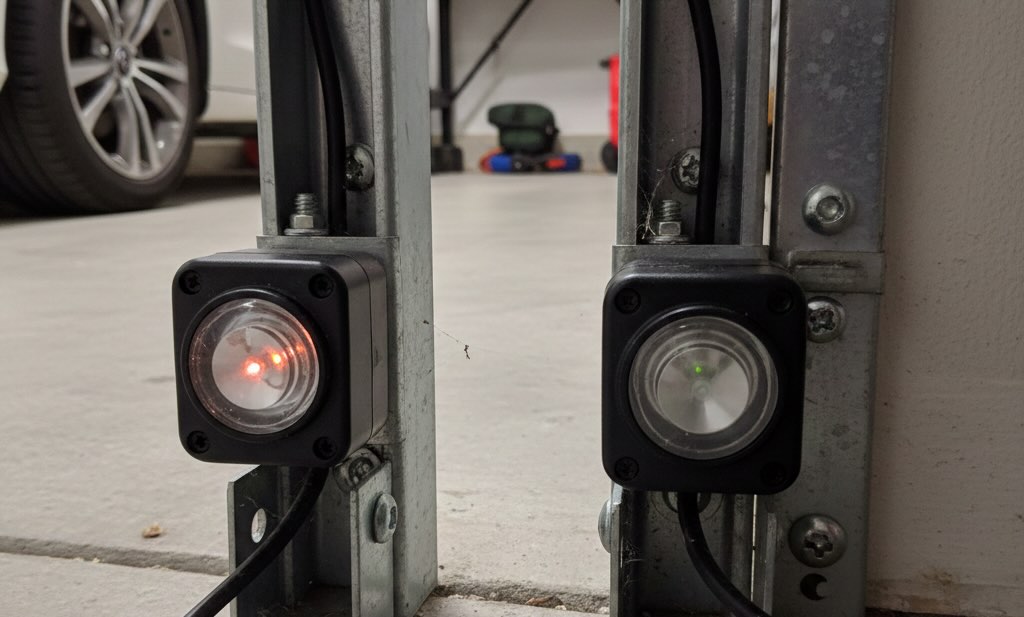
The safety sensors near the bottom of the tracks must face each other perfectly.
Dust, spider webs, or slight bumps can make them malfunction.
5. Check Door Function
Manually open and close the door.
If it binds, sticks, or fails to close fully, the opener can react unpredictably.
Sometimes the problem is mechanical, not electronic.
| Symptom | Likely Cause | What To Check | Fix |
|---|---|---|---|
| Door opens randomly | Stuck remote button | Remove batteries from all remotes | Replace faulty remote |
| Door opens after closing | Sensor misalignment | Inspect and realign safety sensors | Clean and adjust sensors |
| Door opens mostly at night | Signal interference | Reset opener memory | Reprogram remotes |
| Door opens when wall button untouched | Shorted wall wiring | Inspect wires behind wall button | Repair wiring |
Cause #1: A Stuck or Faulty Remote Control
This is by far the most common reason.
And honestly, it feels almost too simple when you finally find it.
The button inside the remote can stick electronically even if it does not feel physically stuck. Moisture, worn contacts, or internal corrosion can trigger constant signals.
I have seen remotes that looked perfectly fine on the outside. No cracks, no damage. But internally, the circuit was closing itself over and over again.
What makes this tricky is that:
You might have multiple remotes
One might be in a drawer
One might be in a vehicle
One might be buried in a purse or tool bag
That is why removing all batteries is such a powerful test. It isolates the issue immediately.
If the door stops opening, you know the problem is remote-based. Then you simply replace the faulty unit. No major repairs needed.
Cause #2: Signal Interference From Nearby Openers
This one feels almost unreal until you see it happen.
Modern garage door openers operate on rolling codes and encrypted signals, but interference is still possible, especially in crowded neighborhoods. In Los Angeles, where homes are close together and wireless traffic is heavy, interference becomes more likely.
Sometimes:
A neighbor installs a new opener
A remote frequency overlaps momentarily
A stored signal is misinterpreted
Your opener receives what it thinks is a valid command.
It does not happen often, but when it does, it feels random and unsettling.
That is why resetting the opener’s memory works so well. It wipes out any stray programming and starts fresh.
Steps:
Hold Learn button 6 to 10 seconds
Light turns off
Memory cleared
Reprogram only your remotes
If the issue stops after this, interference was probably the cause.
Cause #3: Faulty Wall Button Wiring
This one surprises people.
The wall button is nothing more than a simple switch that closes a circuit. If that wire gets shorted, even slightly, the opener thinks the button was pressed.
Common causes:
Staples driven too tight
Wire rubbing against metal
Rodent damage
Old brittle insulation
Sometimes the wiring inside the wall is decades old. Especially in older LA homes.
A tiny nick in insulation can create a phantom signal.
If you remove the wall button from the wall and the door stops opening, you just found your problem.
Cause #4: Safety Sensors That Are Dirty, Misaligned, or Simply Confused
This one feels boring at first, but it causes a surprising number of “ghost opening” problems. The safety sensors are those small units sitting near the bottom of the tracks, one on each side. They talk to each other using an invisible beam. When that beam is broken, the opener reacts.
Normally, they are designed to stop the door from closing on a person, a pet, or even a bicycle tire. But when sensors misbehave, the opener can get confused and sometimes reverse or reopen the door on its own.
In Los Angeles, dust is a real factor. It settles everywhere. Add moisture from coastal air, pollen, or even spider webs, and suddenly the sensor lens is no longer seeing clearly.
Common issues include:
Slight misalignment from a bump or vibration
Dust buildup
Sun glare hitting the sensor at the wrong angle
Loose mounting brackets
Frayed sensor wiring
Sometimes the door closes fully, pauses, then opens again. Other times it opens randomly without any visible pattern. Both can be sensor related.
I have noticed that homeowners often assume sensors either work or fail completely. In reality, they can half-work. That is when the weird behavior starts.
What to do:
Wipe both sensor lenses with a soft cloth
Check that both LED lights are solid, not blinking
Gently adjust alignment until both lights stay steady
Inspect wiring for damage
If the lights flicker even slightly, that is a warning sign.
Cause #5: Logic Board Problems Inside the Opener
This one feels more technical, and it is. But it happens more often than people think.
The logic board is basically the brain of your garage door opener. It processes signals from:
Remotes
Wall button
Safety sensors
Limit switches
If the board is damaged, it can misinterpret signals and trigger the door to open.
What causes logic board damage?
Power surges
Lightning strikes
Old age
Moisture exposure
Manufacturing defects
In areas like Los Angeles, where power fluctuations are not uncommon during storms or grid load changes, this becomes a real risk.
Signs of a failing logic board:
Random opening and closing
Lights turning on by themselves
Remotes working intermittently
Door responding without input
Sometimes the board still works “most of the time.” That is what makes this so frustrating. It feels unpredictable. Like it has moods.
Replacing the logic board is usually cheaper than replacing the entire opener, but it still requires proper diagnosis.
Cause #6: Power Surges and Electrical Noise
This is the invisible cause. You cannot see it, hear it, or smell it. But it can absolutely make your garage door act strange.
Electrical noise comes from:
Large appliances turning on
HVAC systems
Power grid fluctuations
Nearby industrial equipment
A small spike can trigger the opener as if a button was pressed.
This is more common in older homes where wiring is not grounded perfectly. And in LA, with its mix of new construction and 50 year old properties, that situation is common.
A surge protector for the garage door opener can help. It does not solve every case, but it reduces risk significantly.
Sometimes the door only opens during storms or when power flickers. That is a clue.
Cause #7: Environmental Factors People Rarely Think About
This part always surprises homeowners.
Heat causes metal to expand. Cold causes it to contract. Humidity changes sensor behavior. Dust builds up slowly.
Small things:
Track expansion
Opener motor temperature
Plastic sensor housings warping slightly
Condensation on lenses
All of these can alter how the opener interprets its environment.
In summer, especially during LA heat waves, openers work harder. Electronics run warmer. Sensors become more sensitive. That is when random behavior sometimes shows up.
It does not mean anything is “broken,” but it does mean maintenance matters.

When Your Garage Door Opening by Itself Becomes a Security Risk
This is where the situation stops being annoying and starts being serious.
An open garage door is:
An open invitation
A visibility issue
A home access vulnerability
Many burglars do not break into homes directly. They enter through garages because they are quieter and less visible.
If your garage door opens randomly, your home security is compromised. Even if it only happens occasionally, that is enough.
This is why many technicians treat this problem as a priority call.
DIY vs Professional Repair
| Issue Type | DIY Possible | Risk Level | Recommended Action |
|---|---|---|---|
| Stuck remote | Yes | Low | Replace remote or batteries |
| Sensor misalignment | Yes | Low | Clean and realign sensors |
| Shorted wiring | Maybe | Medium | Inspect, call professional if unsure |
| Logic board failure | No | High | Professional diagnosis required |
| Electrical surge issues | No | High | Use technician and surge protection |
Why This Happens More Often in Los Angeles Than People Expect
I think Los Angeles is a perfect storm for this problem. Not because garages are built poorly, but because of the environment and density. Homes are close together, wireless traffic is heavy, and many neighborhoods mix brand new construction with houses that are 40 or 50 years old. That creates contrast in wiring quality, grounding, and signal behavior.
In dense LA areas, your garage opener is not operating in isolation. It is surrounded by:
Dozens of Wi-Fi networks
Smart home devices
Neighboring garage door openers
Electric vehicle chargers
HVAC systems cycling on and off
All of these create background electrical noise. Most of the time it does not matter. Occasionally, it does.
Older garages often have:
Thinner wiring
Less grounding protection
Staples driven too tightly into wire insulation
Wall buttons that have never been replaced
Newer garages sometimes have:
Overly sensitive electronics
Cheap wiring components
Complex smart integrations
Both ends of the spectrum create vulnerability. That is why this issue shows up across all types of homes, from modest bungalows to brand-new builds.
How to Prevent Your Garage Door From Opening By Itself
This is where long-term stability comes from. Not a single repair, but a pattern of care.
1. Clean Sensors Every Few Months
Dust builds slowly. You do not notice it until things behave oddly.
A simple wipe with a microfiber cloth goes a long way.
2. Inspect Wiring Annually
Especially:
Near the wall button
Along the tracks
Around the motor unit
Look for fraying, pinches, or exposed copper.
3. Replace Remotes That Feel “Off”
If a button feels mushy or sticks slightly, replace it. It is cheaper than dealing with security risks.
4. Use a Surge Protector
It adds a layer of defense against unpredictable electrical spikes.
5. Schedule Professional Maintenance
A yearly tune-up prevents most electrical and mechanical issues before they grow.
Full Troubleshooting Checklist
| Step | Action | What It Tells You |
|---|---|---|
| 1 | Remove batteries from all remotes | Confirms or eliminates stuck remote |
| 2 | Reset opener memory | Clears interference or unknown codes |
| 3 | Inspect wall button wiring | Finds electrical shorts |
| 4 | Clean and align safety sensors | Fixes sensor signal instability |
| 5 | Inspect opener power source | Checks for surge issues |
| 6 | Test manual door movement | Detects mechanical resistance |
FAQ: Real Questions Homeowners Actually Ask
Why does my garage door open by itself at night?
At night, electrical demand shifts, temperatures drop, and wireless interference patterns change. Sometimes a weak signal becomes just strong enough to trigger the opener. It is not mystical. Just timing.
Can a neighbor really open my garage door?
With modern rolling codes, it is unlikely, but interference or memory corruption can still cause unexpected behavior. Resetting your opener usually eliminates the risk.
Is this dangerous?
Yes, more than people think. An open garage is a security gap. It also exposes stored items, vehicles, and interior doors.
Should I unplug my opener?
Temporarily, yes, if the door will not stop opening. Long-term, it is better to find and fix the cause.
How much does professional repair usually cost?
Minor repairs are typically inexpensive. Logic board replacement or opener replacement costs more, but it solves the issue permanently.
Final Thoughts
When a garage door opens by itself, it feels unsettling. Almost personal. Like something is wrong with the house. But in nearly every case, it comes down to small electronic misunderstandings. A wire touching metal. A remote aging quietly. A sensor losing clarity. Nothing dramatic, just accumulation.
I think that is what makes this problem frustrating. It is not one big failure. It is several small ones overlapping.
Once you fix it, though, it usually stays fixed. And that peace of mind is worth more than the repair itself.